


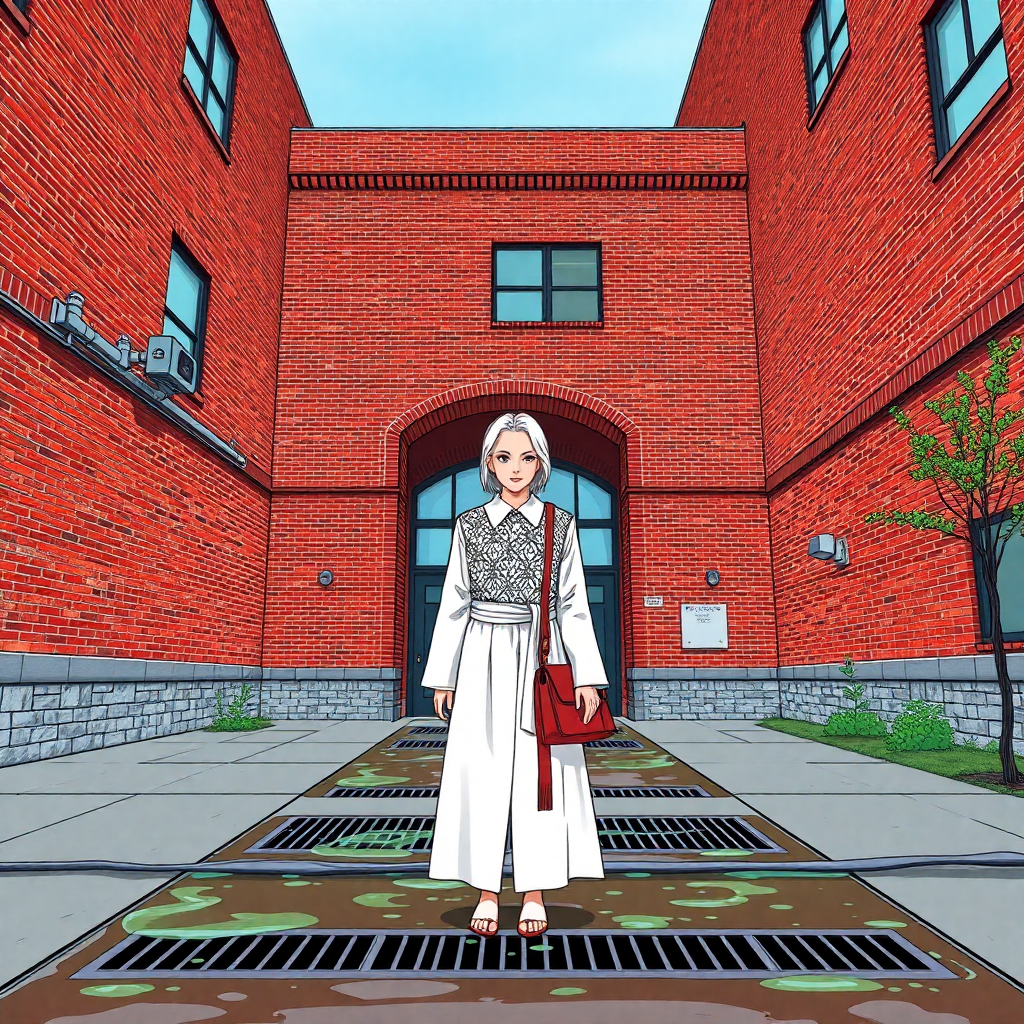
Part One: The Cold Open
The Shore Conference boys volleyball Junior Player of the Year poll had gone live at 7 a.m., and by 7:04 Asbury Park High School’s gymnasium smelled like a greenhouse on fire.
Elena Marisol Tidewell was there because the bleachers were leaking — not water, but the particular green-grey mist that clung to the equipment cage like something had taken root inside the cinderblock walls. She pressed her palm to the scoreboard pillar and felt it: ten seconds forward, the ventilation fan would seize, the mist would thicken, and the varsity setter would collapse before he touched the floor. She shouted. The boy stumbled back just in time.
The mist dissipated. On the scoreboard, the numbers flickered once.
Elena looked at her hand. The crystal lattice across her knuckles refracted the gymnasium’s overhead lights into cold, sharp prisms against the painted floor.
Corwin was dosing the air now. He’d given up on the water.
Part Two: The Investigation
She found Dottie Kern at Asbury Lanes, as expected, rewinding a reel of 1903 survey maps with the focused attention of someone who considered archival maintenance a blood sport. Elena described the mist. Dottie didn’t look up.
“Aerosol delivery,” Dottie said. “Third phase. He said he’d be back in dry season. It’s dry season.”
The new vector was the HVAC infrastructure — every municipal building, gym, and community center in the city drawing from the same ductwork grid that ran under Springwood Avenue. Elena pressed both palms to the Lanes’ original terrazzo floor and pushed her awareness ten seconds forward along every future footfall within half a mile.
What she felt was wrong. Every movement in the Springwood corridor was sluggish — not traffic, but kinetics. Someone was absorbing the momentum from everything that moved through that grid.
That was a different power. Ashvault.
She’d forgotten about Ashvault.
Marcus Ashenbourne — Corwin’s second cousin, thickset and quiet, who’d once stopped a runaway delivery truck on Memorial Parkway by standing in front of it and simply holding still — had apparently decided the family grievance was now his too. His power didn’t poison. It locked. He was holding the ductwork dampers motionless, trapping Corwin’s compound inside the distribution plenum at the old Springwood Avenue Recreation Center, the city’s central ventilation node, just north of the Springwood Arts building. The plan was elegant and infuriating.
Elena ran.
Part Three: The Pivot
She found them both in the recreation center’s mechanical room — Corwin crouched over a pressurized canister of the Strangler, Marcus standing between Elena and everything else like a door that had decided to become a wall.
“You flushed the aquifer,” Corwin said. He sounded genuinely offended, the way a man sounds when someone has corrected him at a dinner party for the third time. “That was a century of formulation.”
“Your grandfather’s work,” Elena said.
“Our grandfather’s work,” Corwin said, “which your grandmother’s survey buried under forty feet of redirected clay pipe.”
There it was. The pivot. Not revenge for profit, or power, or ideology. Just the oldest possible arithmetic: we built something, and you unmade it, and now it’s your turn.
“Last chance,” Marcus said, and did not elaborate.
Part Four: The Reckoning
Marcus moved first — which was, Elena understood in the next nine seconds of accelerated future-sight, exactly what she’d needed him to do.
She saw it before it happened: Marcus throwing his mass into the central pipe junction, kinetic force drawn inward, every moveable thing in the room locking into stillness. The canister would hold. Corwin would open the valve. The compound would have nowhere to go but up through the ducts, and by the time anyone noticed it would be in every public building on Springwood Avenue by mid-morning.
What Marcus hadn’t accounted for was that Elena’s power ran on aquifer pressure — and she’d spent twenty-three years calibrating every water main under that street.
She drove her palm flat against the floor and pushed.
The Cohansey aquifer responded like a dog that had been waiting very patiently to be let outside. A column of pressurized freshwater punched upward through the mechanical room’s inspection access, hit the sealed plenum from below, and blew every ductwork damper simultaneously open — taking the canister with it. The Strangler compound detonated harmlessly into the mechanical room’s exhaust drain in a green-grey cloud that smelled briefly, improbably, of wet bindweed and old hatboxes.
The crystal lattice across Elena’s shoulders blazed white-prismatic as she redirected the remaining pressure through the room’s fire suppression grid. The entire mechanical space was soaked in four seconds. Marcus lost his footing. Corwin, already drenched, sat down on a pipe fitting and stared at his hands as the last of the compound washed from his knuckles into the drain.
She’d trapped the water in a closed loop — the same pressurized column, cycling. There was no kinetic force for Marcus to absorb. He pushed against it and found nothing to push against. He sat down too.
The 1922 Tidewell survey lines had redirected the clan’s trade. Tonight, those same lines had sealed it.
Elena called Dottie from the mechanical room floor, still dripping. “The Monmouth County Clan Tribunal,” she said. “Is that still a thing?”
“I’ve been keeping the calendar warm,” Dottie said.
Part Five: The Resolution
The Tribunal convened three days later at a folding table in the back of Asbury Lanes, which was technically neutral ground and also served very good nachos. The Ashenbourne line was bound under the Corsair Compact — no further synthesis, no ductwork delivery, no aerosol vectors, no brackish grievance enacted within Monmouth County limits for a generation. Marcus was fined seven jars of documented clan compounds, all surrendered to Dottie’s archive. Corwin signed without speaking.
Elena lost the aquifer connection for eight days after the push — the lines too spent to echo back. She spent them watching the Atlantic from the Springwood waterfront and sensing absolutely nothing, which was the closest thing to a vacation she’d had in years.
It wasn’t peace. It was more like a treaty between weather systems. But the gymnasium was clean, the ducts were flushed, and the boys volleyball team went undefeated through the week.
Dottie filed the Tribunal paperwork under Ashenbourne (inactive) and added a small sticky note: “For now.”
Sources
- 25 teams are in the softball Shore Conference Tournament. Seedings, schedule
- NJ ex-fireman ‘ready for war’ when he launched into violent rampage triggered by breakup: prosecutors
- Koyo Premiere New Single & Music Video “Barely Here” From Brand New Album
- Shore boys volleyball Junior Player of the Year poll from Alliance Orthopedics
- Nonpoint Premiere New Single & Lyric Video “Is It” From Upcoming New Album “The Last Word”
- Lucy Dacus Unveils Reflective New Single “Planting Tomatoes”: Stream
- Where to Find Tickets to the Strokes’ 2026 Reality Awaits Tour
- 2 Jersey Shore BMX scene trailblazers stoked for new X Games League
- VOTE Who was the Shore Conference’s top baseball player for Week 3?
- Jackson High School merger helped two track & field stars take off
- Asbury Park, New Jersey — Wikipedia
- U.S. Census Bureau, American Community Survey 5-Year Estimates (2022)